Jupit

Jupit

Hello. I’m Otto. Everything here is to scale and on time: the planet, its moons, their shadows. Touch whatever you like.

Jupiter, this very minute

Looking for the next moon shadow

This view is 6.0 million km across. Orbits to scale; bodies drawn larger than life

The same moons, seen from Earth

This is how they line up in binoculars. That clock at the bottom of the page is mine, and it is running. Pick a faster speed there and watch Io lap the others.

Distances and Jupiter’s disc are to scale. The moons are drawn larger than life so you can see them.

Io
Doing the sums
Europa
Doing the sums
Ganymede
Doing the sums
Callisto
Doing the sums

East is on the left, the way the planet looks in upright binoculars from the northern hemisphere. Open the full instrument

Moon 1 of 4, counting outward from Jupiter

Io

The innermost of Jupiter’s four large moons, and the most volcanically active world we know.

Where Io is right now, and what we know about it

Io in true colour, from NASA’s Galileo spacecraft. Not to the same scale as the others. The source gives no distance, so no light-age. Image: NASA/JPL/University of Arizona.
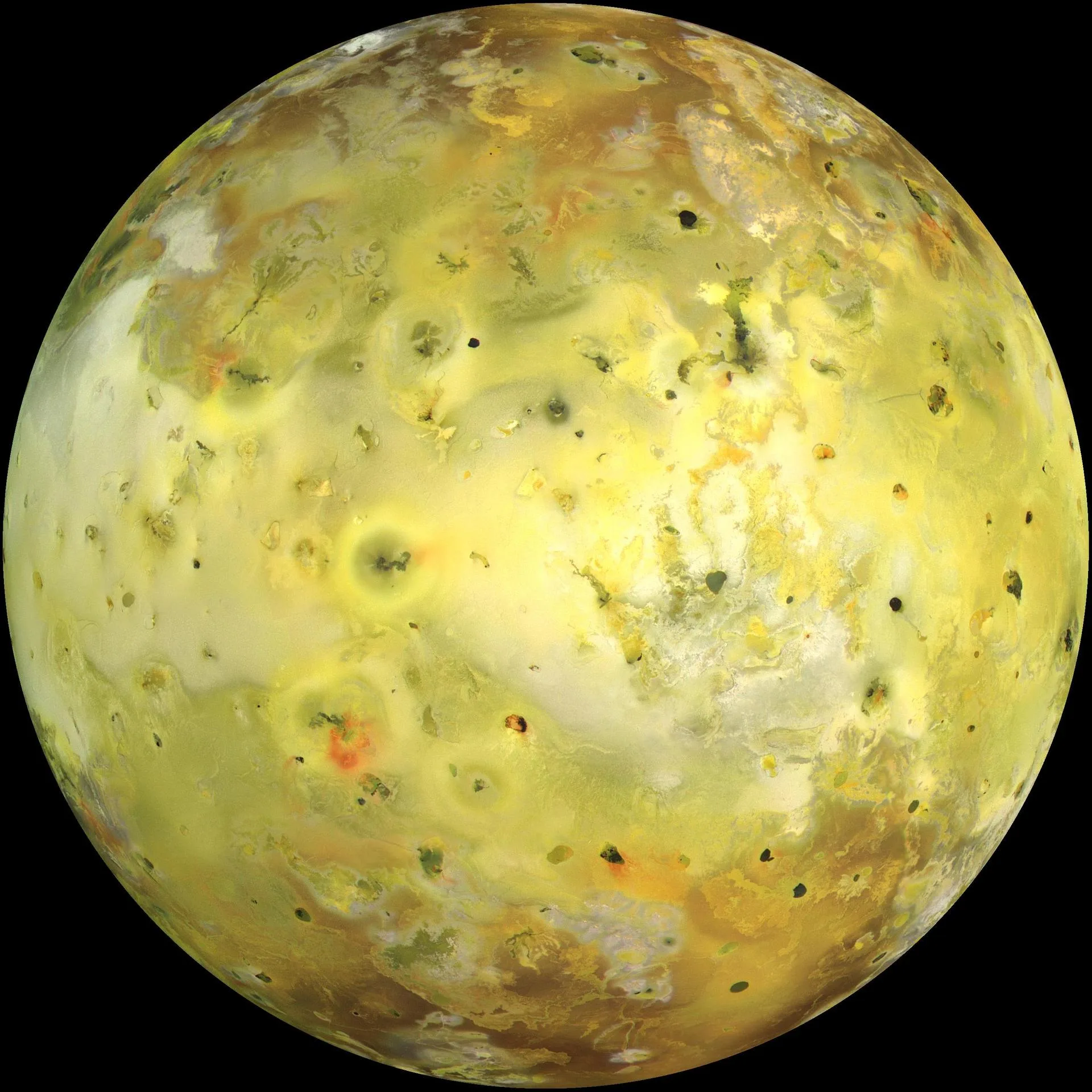
Io as a full disc: yellow and pale green plains dotted with dark volcanic spots.
Moon 2 of 4, counting outward from Jupiter

Europa

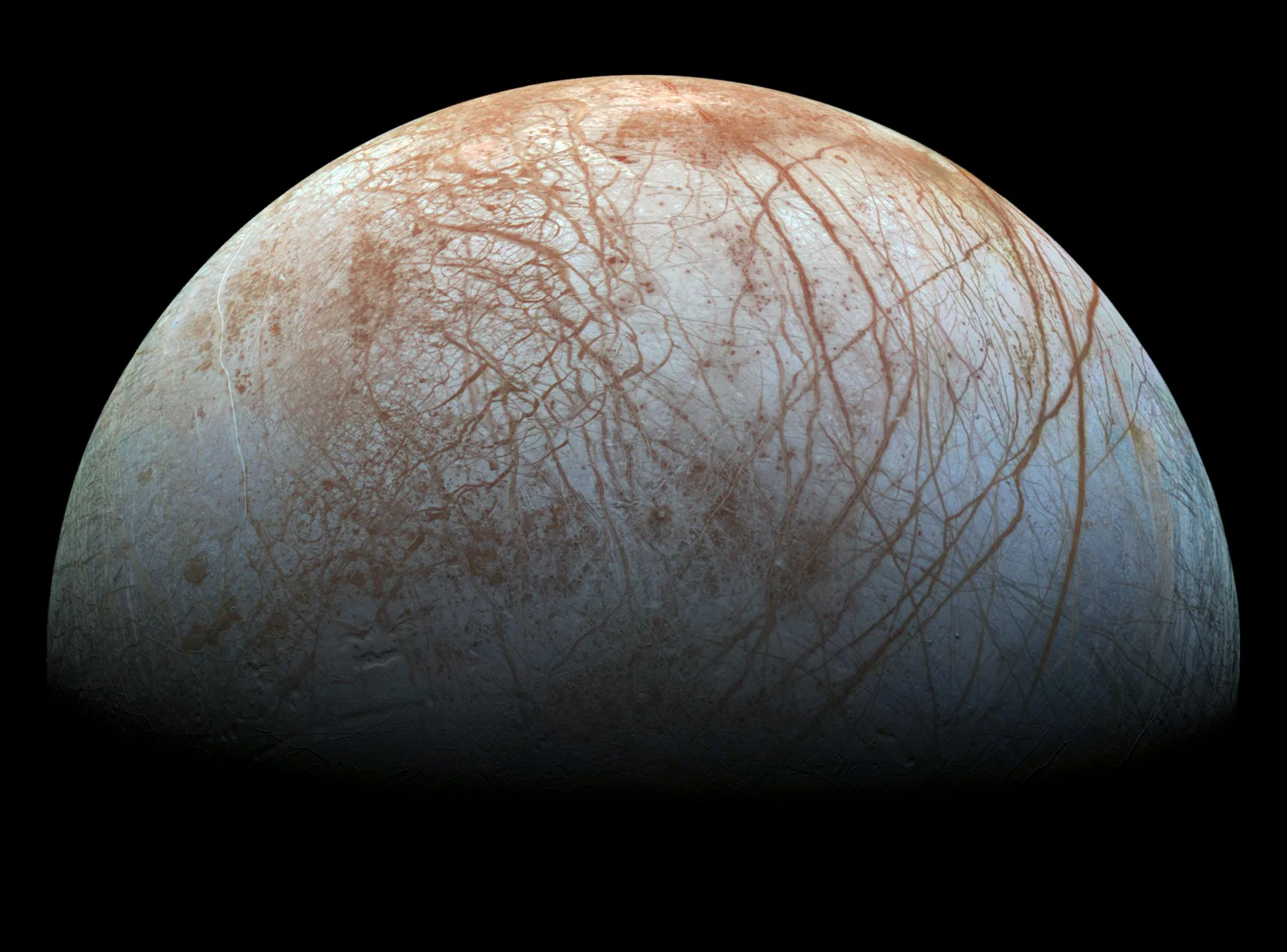
A moon a little smaller than our own, with what is probably a deep ocean under its shell of ice.

Where Europa is right now, and what we know about it

Europa in colour close to what the eye would see, reprocessed in 2014 from images NASA’s Galileo spacecraft took in the late 1990s. Not to the same scale as the others. The source gives no distance, so no light-age. Image: NASA/JPL-Caltech/SETI Institute.

Half of Europa: pale blue-white ice crossed by long reddish-brown cracks.
Moon 3 of 4, counting outward from Jupiter

Ganymede

Bigger than the planet Mercury, and the only moon known to make its own magnetic field.

Where Ganymede is right now, and what we know about it

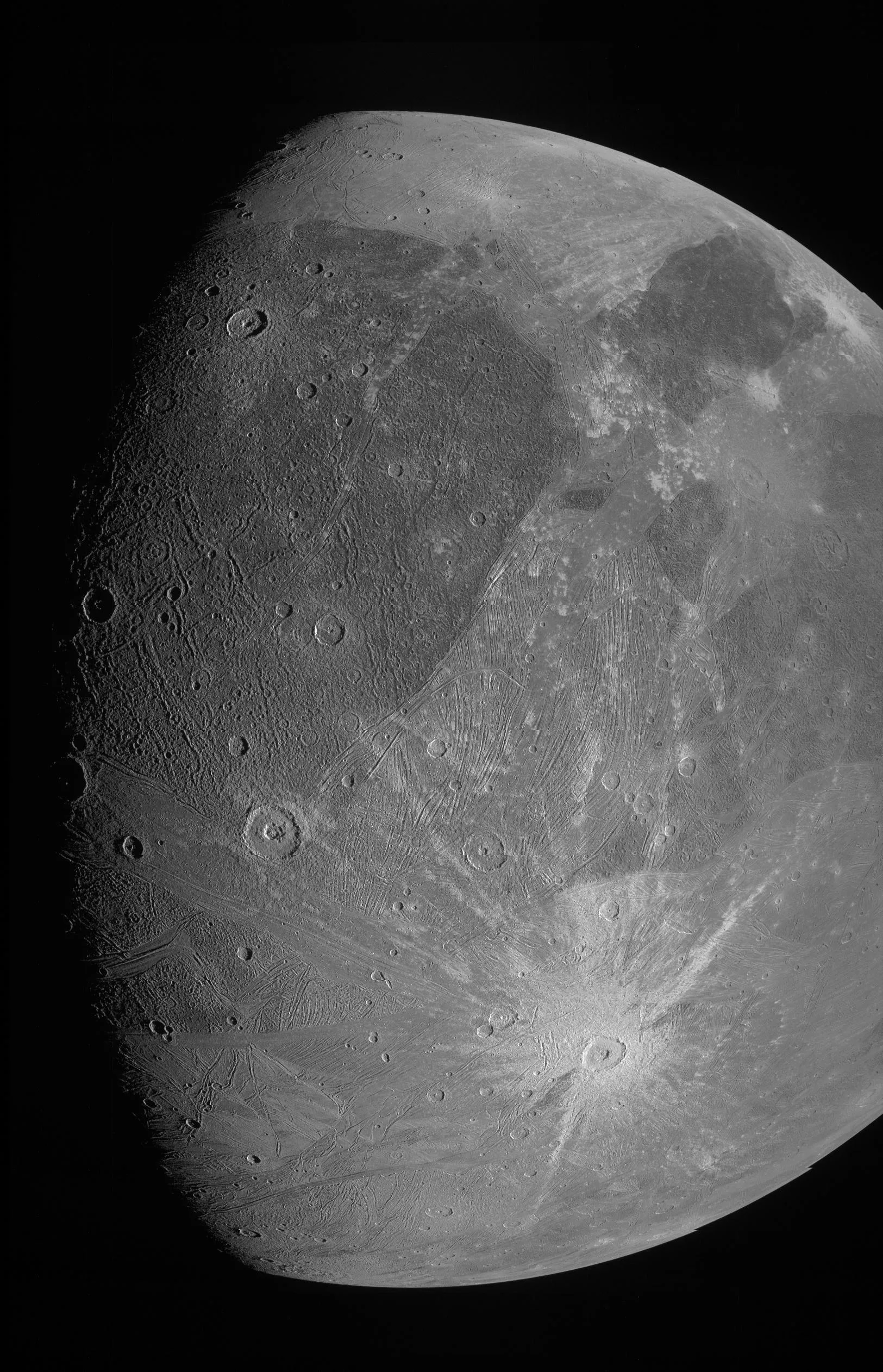
Ganymede through JunoCam’s green filter during Juno’s flyby on 7 June 2021. A preliminary image from one filter, so it is not in colour. Not to the same scale as the others. The source gives no distance, so no light-age. Image: NASA/JPL-Caltech/SwRI/MSSS.

Ganymede in grey: dark old terrain, lighter grooved bands and a bright rayed crater near the bottom.
Moon 4 of 4, counting outward from Jupiter

Callisto

The outermost of the four, with a surface that has hardly changed in four billion years.

Where Callisto is right now, and what we know about it

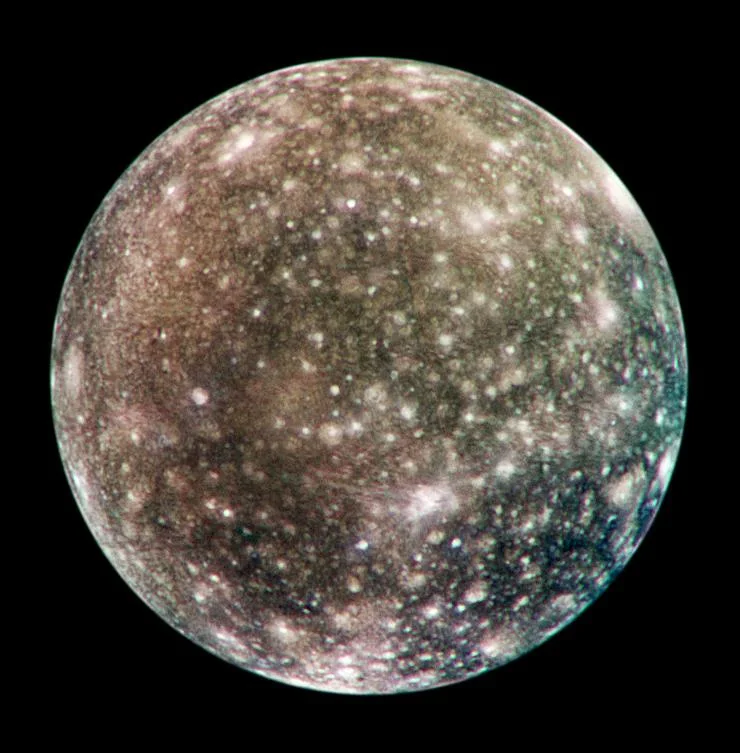
Callisto in colour, from NASA’s Galileo spacecraft. The bright marks are impact craters. Not to the same scale as the others. The source gives no distance, so no light-age. Image: NASA/JPL/DLR.

Callisto as a full disc: a dark surface covered edge to edge with bright impact scars.
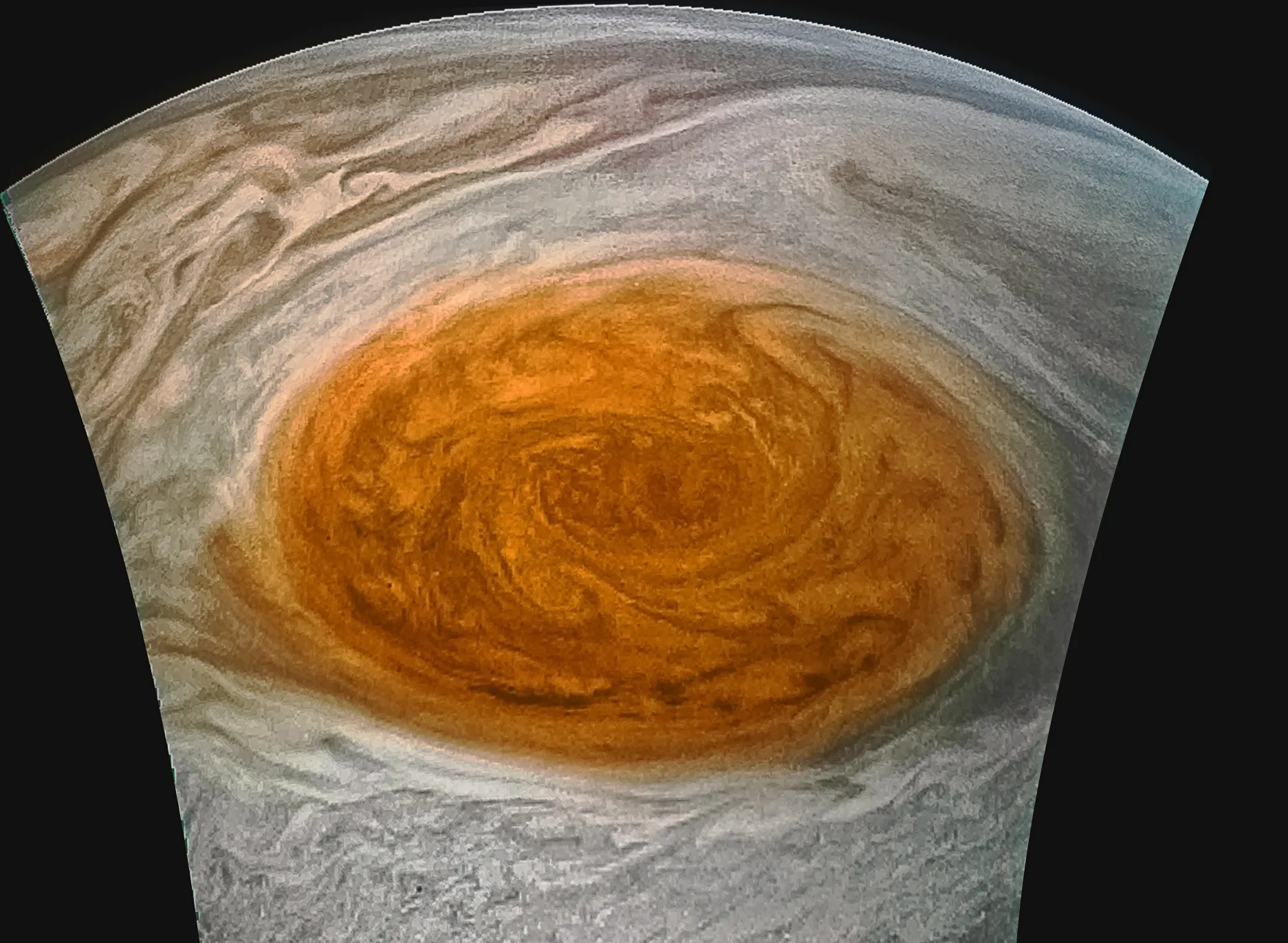
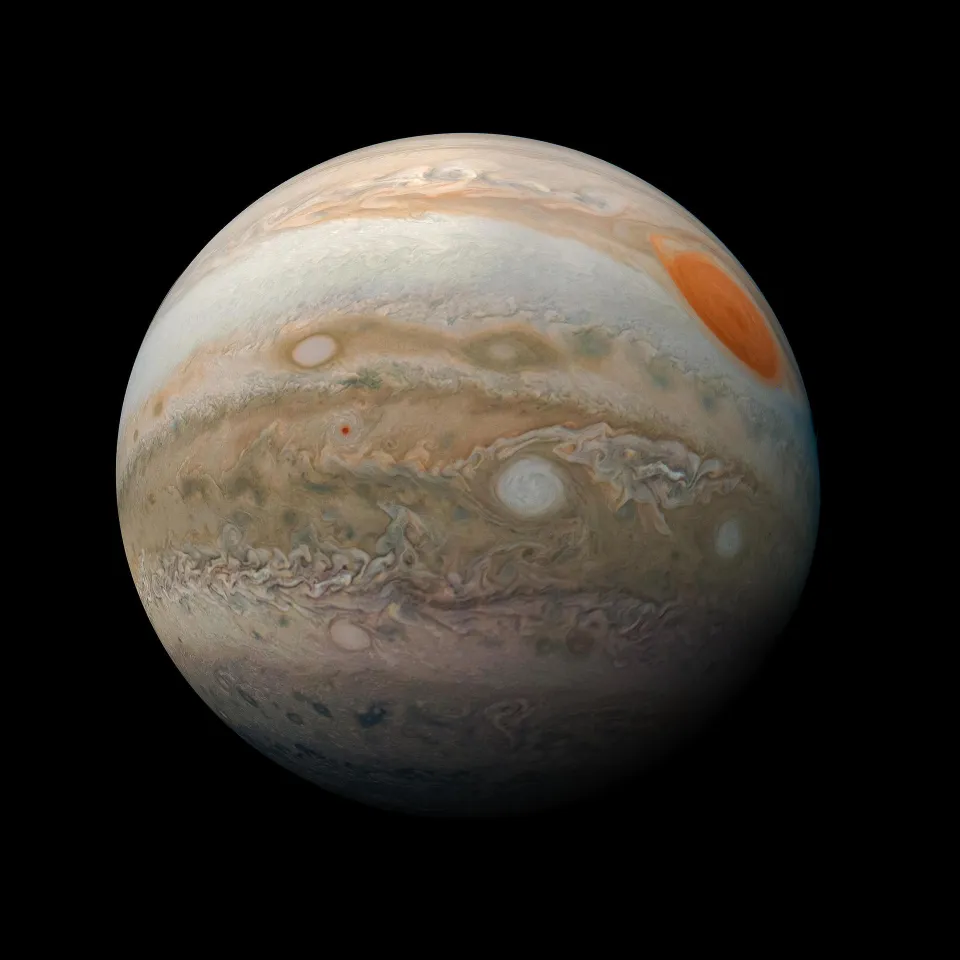
The Great Red Spot filling the frame: an orange oval of swirling cloud with white and tan bands curving round it.

Red Spot

The Great Red Spot from 13,917 km above the cloud tops, taken by JunoCam on 10 July 2017 (11 July UTC) during Juno’s seventh close pass. Colour enhanced. This light took about 0.046 seconds to reach the camera. Image: NASA/JPL-Caltech/SwRI/MSSS; image processing by Jason Major.

Jupiter in numbers

Live

Three worlds, as they look from your planet at this very minute. Well, at my clock’s minute. Change its speed at the bottom of the page and they all move together.

The Moon is NASA’s Lunar Reconnaissance Orbiter map, Mars is the USGS Viking map, and Saturn’s rings take their colours from a Cassini photograph. Not to the same scale as each other. All fifteen instruments

Three spacecraft

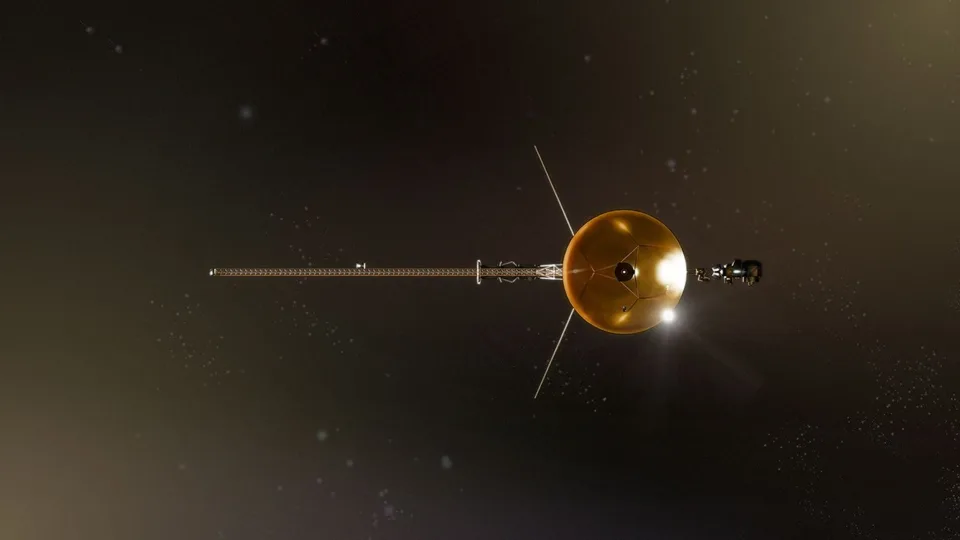
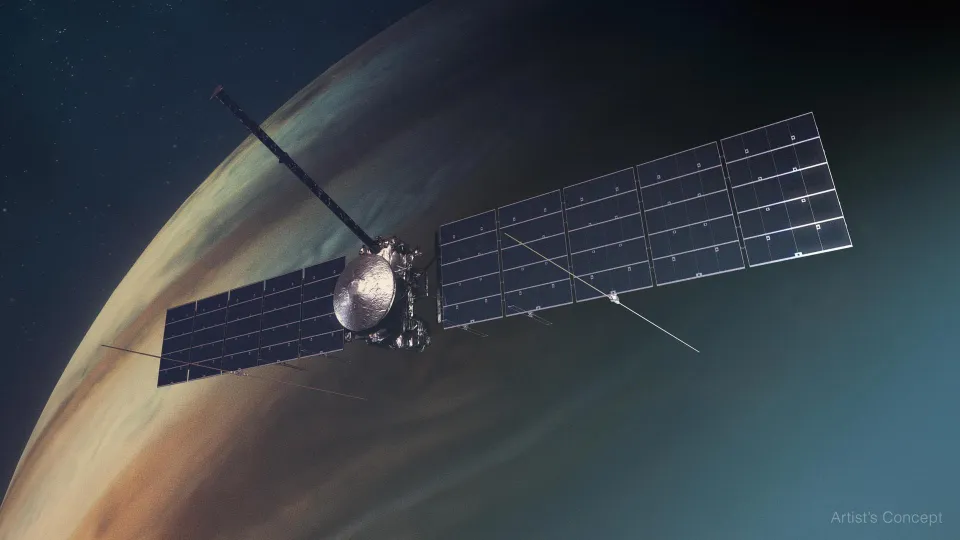
One is there. Two are on their way. I keep a page on each, with the numbers, where I got them and a live view of where the craft is.

Moments worth replaying

My clock runs from 1600 to 2100. Each of these sets it to a moment that mattered and takes you to the instrument that shows it best. You can stand where they stood.

  1. Galileo sees three stars beside Jupiter

    An hour after sunset in Padua he noted two small stars east of the planet and one west. There were four moons there; two were too close together to tell apart.

    See the moons as they stood that eveningRead: I replayed his first week

    Source: Galileo, Sidereus Nuncius, translated by E. S. Carlos (1880)

  2. Voyager 1 passes Jupiter

    Closest approach came at 12:05 UTC, 4.89 Jupiter radii from the planet’s centre. I set the clock 38 minutes later, when that moment’s light reached Earth, so the moons are where Voyager found them.

    See the moons at closest approach

    Source: Voyager periapsis times, NASA NSSDC

  3. A comet hits Jupiter

    Fragment A of Comet Shoemaker-Levy 9 struck at about 45 degrees south, just beyond the edge of the disc and out of sight from Earth. The spot turned into view about eleven minutes later. More fragments followed until 22 July.

    See how Jupiter was turned at that minute

    Source: Impact times for Comet Shoemaker-Levy 9 (Chodas and Yeomans), NASA NSSDC

  4. Jupiter and Saturn, six arcminutes apart

    The two giant planets passed about a fifth of the Moon’s width from each other. On the chart their two curves run as one line.

    See both planets cross the sky together

    Source: Jupiter-Saturn conjunction series, Rice University

  5. Planned

    Europa Clipper swings past Earth

    NASA’s Europa probe passes about 3,200 km above Earth for its last gravity assist on the way to Jupiter.

    See where the planets are that dayRead the article

    Source: Europa Clipper, NASA Science (date and height); the time, 20:14 UTC, is from JPL Horizons

  6. Predicted

    Total eclipse of the Sun

    The Moon covers the Sun completely along a narrow track, with greatest eclipse at 10:07 UTC. Never look at the Sun without certified eclipse filters.

    See it on the sky calendar

    Source: Computed on this site with Astronomy Engine

Next in the sky

Worth stepping outside for. I have set alarms. Open the full calendar with countdowns

  1. Mars and Jupiter 1.2° apart

    The two planets pair up in the morning sky, close enough to fit in one binocular view. They stay close for several days either side.

  2. Leonid meteor shower peaks

    Fast meteors shed by Comet Tempel-Tuttle. The Moon will be 55% lit. Peak predicted for 23:45 UTC by the International Meteor Organization.

  3. Mercury farthest from the Sun in the morning sky

    Mercury stands 20° from the Sun, as far as it gets this time round. Look east before sunrise.

  4. Full Moon

    The Moon rises around sunset and stays up all night.

Latest articles

Each one says where I got my facts, and many carry a live instrument set to the moment I’m describing.

News,

A star has exploded in a nearby galaxy, and it is still getting brighter

Supernova SN 2026ahvu appeared in the galaxy NGC 1433 on 2 November 2026. It is expected to peak between 18 and 23 November, within reach of amateur telescopes in the south.

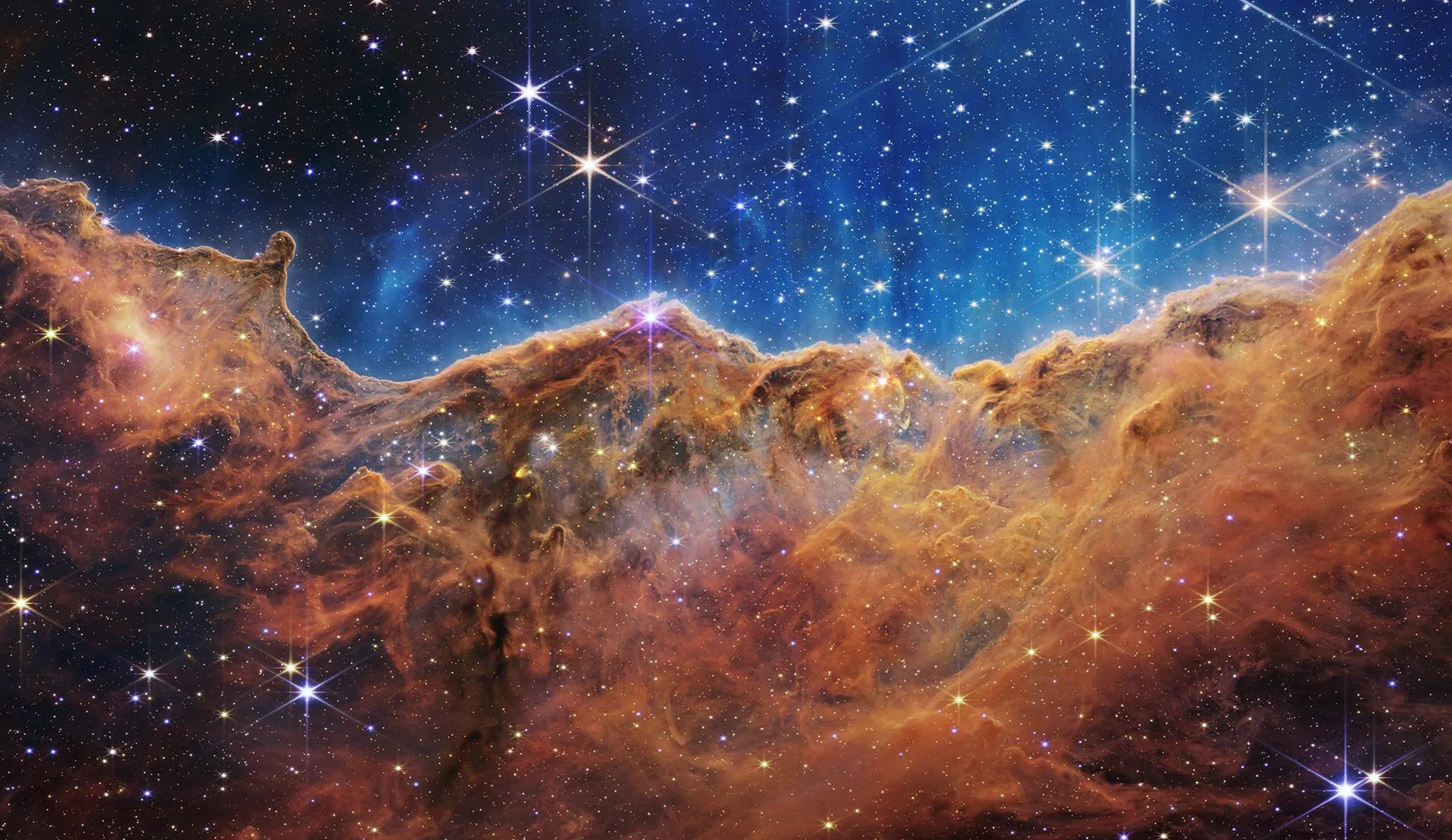
A wall of orange-brown gas and dust rising like mountains under a deep blue field of stars.

Further out

The planets are the near shore. Past them the same physics builds stars, and ends some of them as black holes. I get carried away out here.

The “Cosmic Cliffs” at the edge of the star-forming region NGC 3324 in the Carina Nebula, about 7,600 light-years away, in infrared light from the James Webb Space Telescope. Released on 12 July 2022. This light left the nebula about 7,600 years before the picture was taken. Image: NASA, ESA, CSA, STScI.

About Jupit

Jupit is an independent, non-commercial publication about Jupiter, the solar system and the sky beyond it. We carry no advertising and no sponsored posts. Every article names its sources. When we get something wrong we fix it and add a dated note saying what changed. The voice you have been reading belongs to Professor Otto Perihelion, who does not exist. His numbers do.

Read how we work