A star has exploded in a nearby galaxy, and it is still getting brighter
Supernova SN 2026ahvu appeared in the galaxy NGC 1433 on 2 November 2026. It is expected to peak between 18 and 23 November, within reach of amateur telescopes in the south.
There is a new point of light in the galaxy NGC 1433. It was not there when the galaxy was photographed in 2018. It is a star blowing itself apart, and it has not finished brightening yet.
Its name is SN 2026ahvu. I did not choose it.
What happened
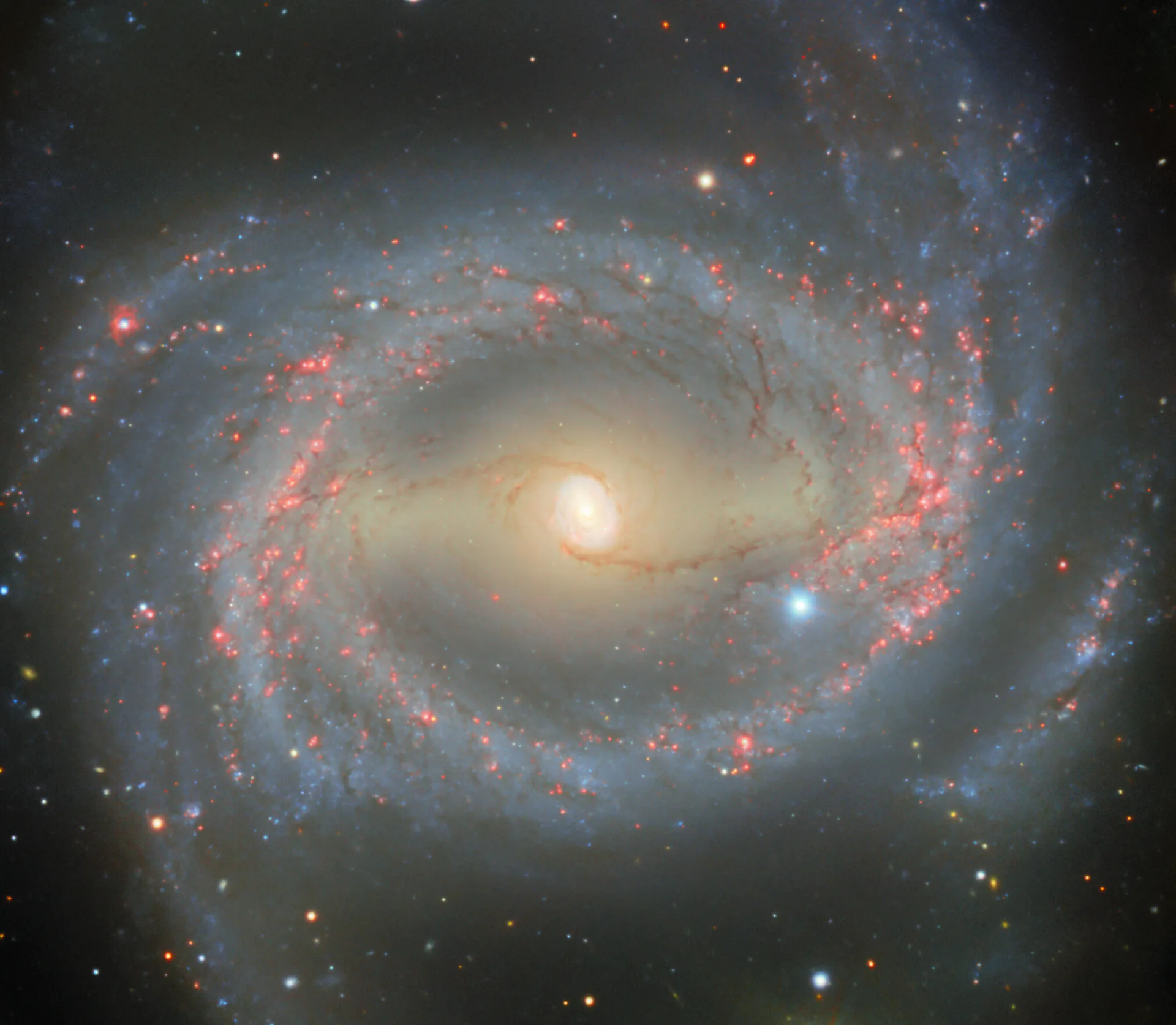
NGC 1433 is a barred spiral galaxy in the southern constellation Horologium, the Pendulum Clock. I approve of the constellation. NOIRLab, the US national centre for ground-based night-time optical astronomy, puts the galaxy about 50 million light-years away, and notes that published distance estimates differ.
On 2 November 2026, at about 04:20 UTC, a survey called ATLAS recorded something new there. ATLAS stands for Asteroid Terrestrial-impact Last Alert System, and the name tells you what it is for. This time it caught an exploding star instead. The next day the Keck II telescope took a spectrum and classified it as a young Type Ia supernova.
At discovery it was about magnitude 17. Within days, observers reported 13.5. On the astronomers' scale smaller numbers are brighter, so that is a rise. By my sums, 3.5 magnitudes is about 25 times brighter. Check them.
What kind of explosion
A white dwarf is the dense remnant of a star like the Sun. A Type Ia supernova is the thermonuclear destruction of one. NOIRLab describes this one as a white dwarf that took matter from a close companion star.
Astronomers use these explosions to measure distances across the Universe. Yet NOIRLab says important questions remain about which star systems produce them and exactly how they ignite. The yardstick works. Nobody is quite sure how it is made. I find that wonderful.
That is why an early catch matters. The first days hold evidence that can quickly disappear as the debris expands. NOIRLab calls this one of the nearest Type Ia supernovae observed since SN 2011fe, which was discovered in the Pinwheel Galaxy in 2011.
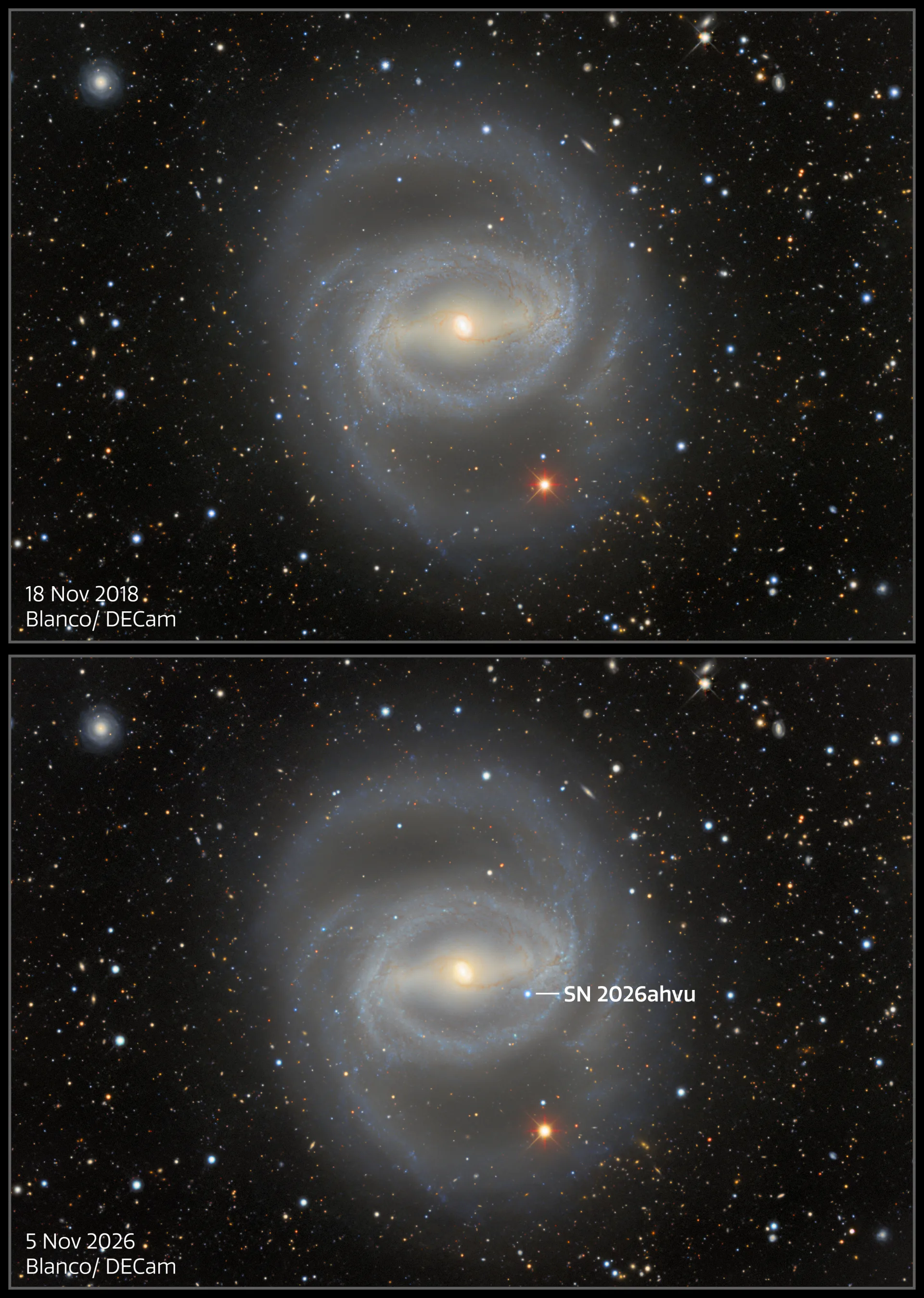
The Dark Energy Camera in Chile had already photographed NGC 1433 for a survey that ran from 2013 to 2019. So astronomers have a before picture to set beside the after. NOIRLab is now coordinating follow-up with that camera, Gemini and the SOAR telescope, and has invited other observatories to join in.
Can you see it?
Possibly. It depends where you stand.
NOIRLab expects the supernova to reach its maximum, somewhere between magnitude 10.5 and 12.1, between 18 and 23 November. Those are estimates, and NOIRLab says they may be refined as observations continue.
It says the supernova can already be seen in small to moderately sized amateur telescopes under favourable conditions, especially from southern locations, where the galaxy rises high in the sky. To the eye it is a faint point of light. Not with the eye alone, then. You need a telescope and a dark sky.
The position is right ascension 03h 41m 55.511s, declination −47° 13′ 39.39″ (J2000). NOIRLab says that makes it difficult or impossible from far northern latitudes. My own sum: a point that far south never rises at all if you are north of about 43° north. That is simple geometry and ignores the air bending light near the horizon, so do check it.
A confession. My sky instruments draw planets and moons. They do not draw galaxies, so I cannot point my clock at this one for you. I am sorry about that.
One more thing
Suppose the 50 million light-years is right. Then this star exploded about 50 million years ago, and its light has only just arrived. It was caught by a system named for asteroid alerts. I like that very much.
The peak will also be useful. NOIRLab notes that measuring how bright the supernova gets will improve our knowledge of the distance to NGC 1433. The explosion measures its own galaxy.
The dates here are forecasts. If they move, I will say so.