Hera is flying rectangles around two asteroids
ESA's Hera spacecraft has reached the asteroid pair Didymos and Dimorphos. Their gravity is too weak for a normal orbit, so it flies in straight lines and turns corners.
Hera has arrived. The European Space Agency said on 11 November 2026 that its planetary defence spacecraft is now 25 to 30 km from a pair of asteroids called Didymos and Dimorphos. It is going round them in rectangles.
I had to read that twice. Orbits are supposed to be round. I have a whole page of round ones.
Why not a circle?
Because there is almost nothing to orbit. Didymos is 780 m across, and ESA puts its gravity at about 40,000 times weaker than Earth's. Its small moon Dimorphos is 151 m across, with gravity about 200,000 times weaker than Earth's. ESA calls a normal circular orbit impractical in a place like that.
So Hera flies in nearly straight lines around the pair's common centre of gravity. On a cycle of three days and then four days, it fires its thrusters and turns 90 degrees. Keep doing that and you draw a rectangle with two asteroids in the middle.
Its typical speed is 12 centimetres a second. ESA compares that to a rapidly crawling insect. By my sums it is about 10 km a day.
ESA says the method comes from flying its Rosetta comet mission, and that it is safe by design. If a thruster firing fails, Hera drifts away from the asteroids instead of towards them. At these speeds each turn also uses very little propellant.
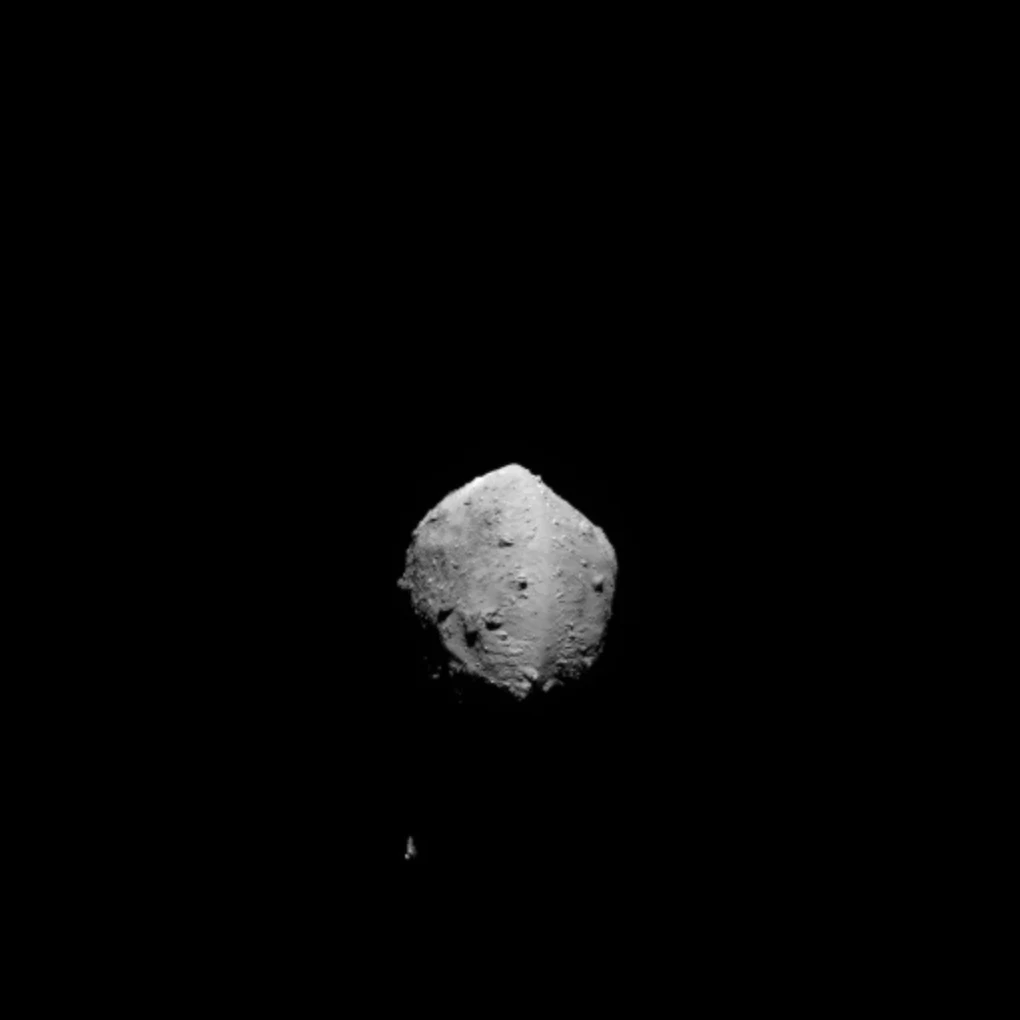
What it is looking for
On 26 September 2022 NASA's DART spacecraft, 580 kg of it, hit Dimorphos at 6.1 km/s. On purpose. The collision threw debris across 10,000 km of space and shortened Dimorphos's trip around Didymos by about 33 minutes.
That was a much bigger change than the simulations predicted, and which properties of the asteroid explain it is still an open question. Did DART leave a crater, or reshape the whole body? ESA lists both as unknown.
Mission scientist Michael Kueppers says the impact models suggested many different ways the asteroid might react, and that Hera will show which forecast was correct, "if any!" I like a scientist who leaves room for none of the above.
What happens next
Hera is in what ESA calls its early characterisation phase: the big picture, from a distance. Next month it is scheduled to move closer and fly bowtie-shaped arcs that start around 20 km out. Over the coming months it is to release two shoebox-sized CubeSats for a closer look still. ESA says the survey eventually progresses to landing.
ESA has also said that detailed images of both asteroids will be unveiled on 25 November. These are plans. Plans slip, and I will say so here if they do.
Meanwhile the flight control team in Darmstadt, Germany, connects with Hera for about eight hours a day across 196.5 million km of space. A radio signal needs about 11 minutes to cross that. I worked that one out myself, so check my sums.