Hear a pulsar spin
Take a star. Let it explode. What’s left is the size of a city and spinning, so steadily that its radio beam sweeps past Earth like a lighthouse lamp. Choose one and listen. That ticking is a dead star keeping better time than my watch.
A diagram, not to scale. It turns while the sound plays.
About 30 turns a second
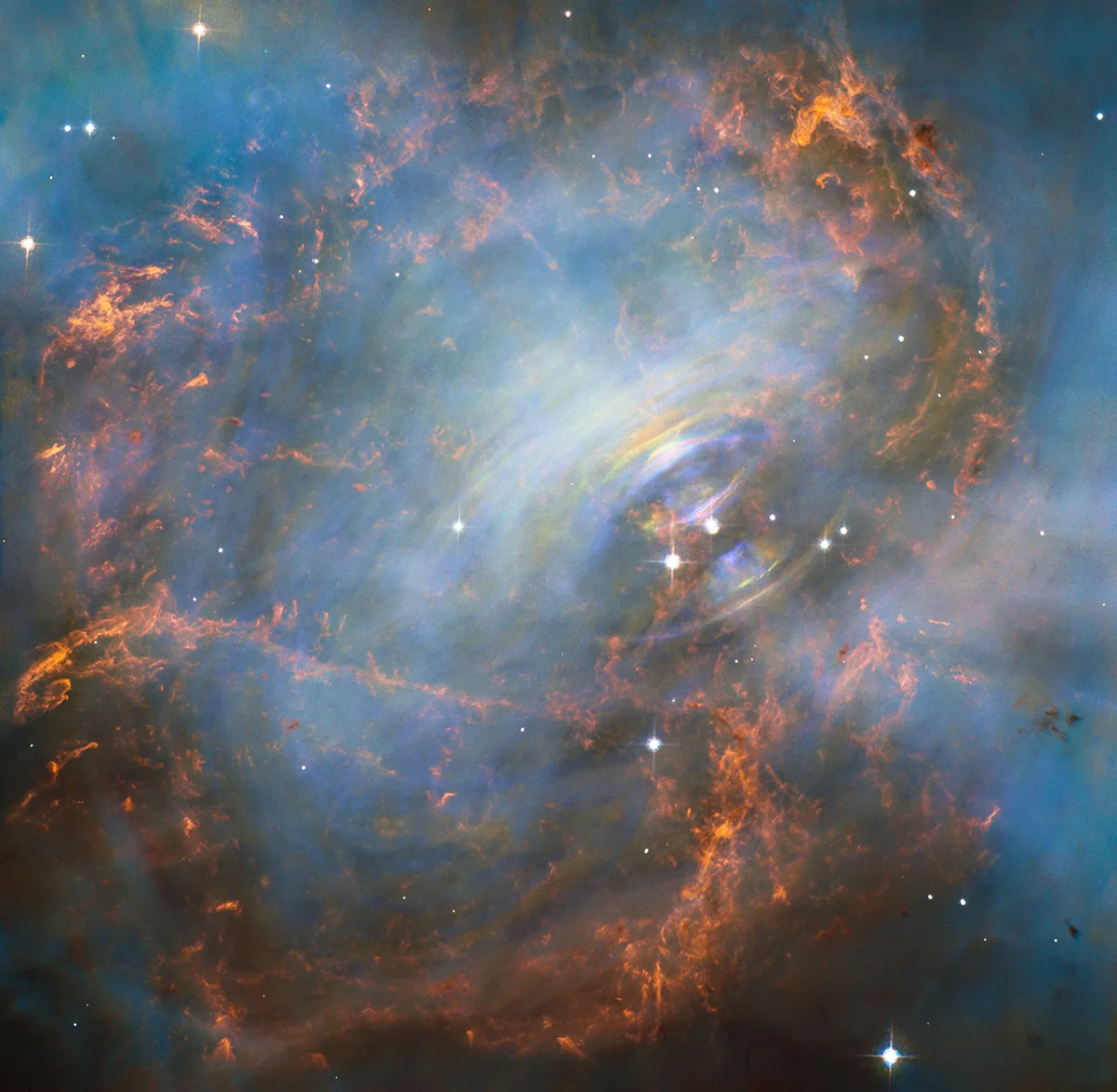
The star left by the supernova of 1054, at the heart of the Crab Nebula 6,500 light-years away. It spins about 30 times a second.
Each tick is one turn of the star. The tick is a sound I chose. Only its timing is real. Radio telescopes pick the pulses up as radio waves.
- Speed of its equator, if it is 20 km across
- 1,885 km/s
- 0.6% of the speed of light. Its size has not been measured; 20 km is NASA’s round figure for a neutron star.
- What it is
- A star the size of a city
- The core of an exploded star: about the mass of the Sun pressed into a ball some 20 km across. A sugar cube of it would weigh about a billion tonnes on Earth (NASA).
- Where the spin rate comes from
- NASA’s Hubble Captures the Beating Heart of the Crab Nebula (2016)
My diagram never turns faster than once in four seconds, whatever the star does, so nothing on this page flashes. Spin rates given as “about” are as round as their sources. Pulsars slow down over the years, so each rate is the one published, not today’s to the last digit.