Europa
A moon a little smaller than our own, with what is probably a deep ocean under its shell of ice.
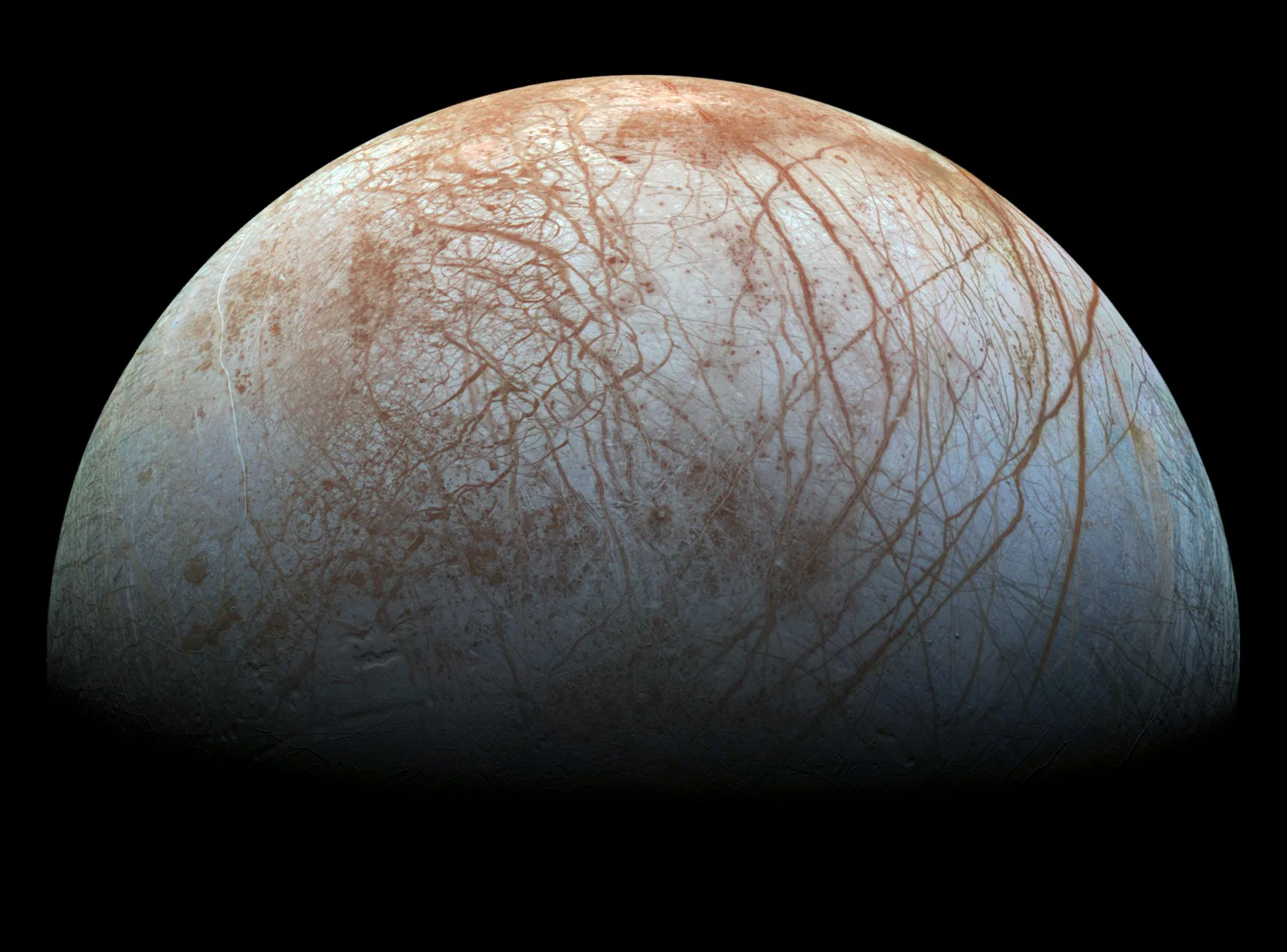
Europa in colour close to what the eye would see, reprocessed in 2014 from images NASA’s Galileo spacecraft took in the late 1990s. The source gives no distance, so no light-age. Image: NASA/JPL-Caltech/SETI Institute.
- Distance from Jupiter
- 671,100 km
- One orbit
- 3.55 days
- Diameter
- 3,122 km
- First seen as a separate moon
- 8 January 1610, by Galileo
Europa at the site clock’s time
Wind my clock at the bottom of the page and this follows.
- Doing the sums
- What this is
- The United States Geological Survey’s map of Europa, built from Voyager and Galileo images, wrapped on a sphere and lit from where the Sun is. The only global map is black-and-white, so there is no colour here. Blurred or black patches are places no spacecraft has photographed well. Drag it sideways to wind time and watch it turn.
- What is simplified
- Europa is drawn keeping one face exactly toward Jupiter, with its axis parallel to Jupiter’s. The real moon rocks about a degree or less either way.
Distances and Jupiter’s disc are to scale. The moons are drawn larger than life so you can see them.
- Io
- Doing the sums
- Europa
- Doing the sums
- Ganymede
- Doing the sums
- Callisto
- Doing the sums
- Europa from Earth, at the site clock’s time
- Doing the sums
- Next time its shadow crosses Jupiter
- Looking
- What 70 kg on Earth would weigh there
- 9.4 kg
- From its surface gravity of 1.31 m/s² (NASA).
What we know
The ocean
Scientists believe a salt-water ocean lies beneath Europa’s ice, holding about twice as much water as all of Earth’s oceans. I think about this more than is healthy. NASA’s figures put the ice shell at 15 to 25 km thick and the ocean beneath it at 60 to 150 km deep.
The best evidence is magnetic. The Galileo spacecraft found that Jupiter’s magnetic field is disturbed around Europa in the way a layer of salty, electrically conducting water would disturb it. NASA’s own summary is careful, and so am I: the evidence is strong, but the ocean still awaits confirmation by a later mission.
The surface is young, no more than 40 to 90 million years old, which means something keeps renewing it.
Galileo saw Europa on 7 January 1610 but could not tell it from Io until the next night. The German astronomer Simon Marius claimed to have seen Jupiter’s moons at about the same time, and is often named as co-discoverer.
Visitors
Pioneer 10 and 11 and the two Voyagers saw Europa in passing. Most of what we know comes from the Galileo orbiter, which made twelve close flybys. Juno has flown past as well.
Two spacecraft are now on their way. NASA’s Europa Clipper, launched on 14 October 2024, is the first mission built to study Europa in detail. ESA’s Juice is planned to make two flybys in July 2032.