Jupiter
The largest planet, the four moons Galileo found beside it, and the spacecraft there now or on their way. It is my favourite. I am not neutral about this.
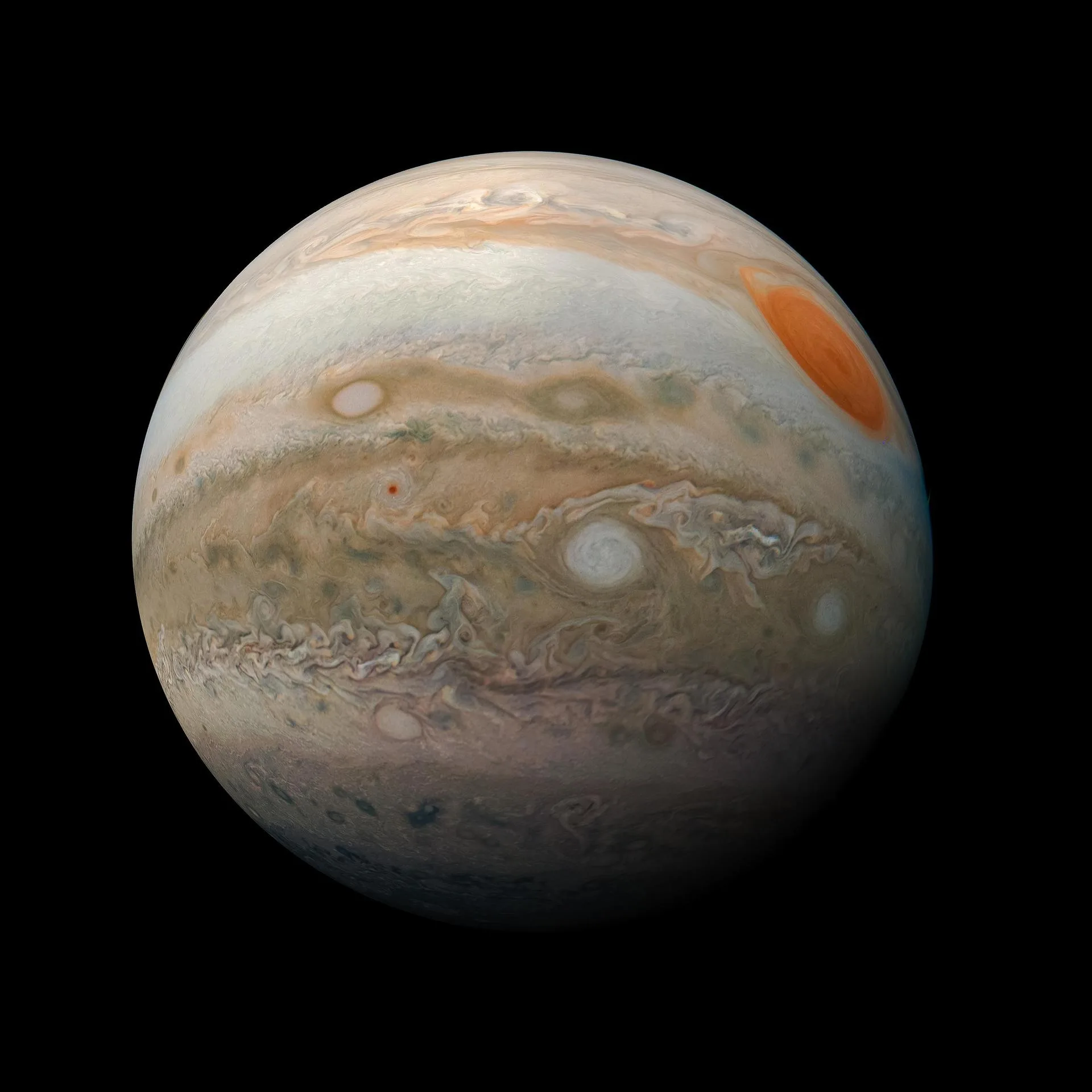
Jupiter’s southern hemisphere and the Great Red Spot, from three JunoCam images taken on 12 February 2019. Colour enhanced. The source gives no distance, so no light-age. Image: NASA/JPL-Caltech/SwRI/MSSS; image processing by Kevin M. Gill, CC BY.
- Mass
- 318 Earths
- Width at the equator
- 142,984 km
- One turn on its axis
- 9 hours 55 minutes
- One trip round the Sun
- 11.86 Earth years
- Mean distance from the Sun
- 5.2 au (778 million km)
- Moons recognised
- 115
From Jupiter Fact Sheet, NASA NSSDC and Jupiter moons, NASA Science (115 moons recognised; page updated September 2026). NASA’s older fact sheet still lists 95 moons; the count rises as small ones are confirmed. See Jupiter as it looks from Earth right now
The four large moons
Where they are at the site clock’s time, as seen from Earth.
Distances and Jupiter’s disc are to scale. The moons are drawn larger than life so you can see them.
- Io
- Doing the sums
- Europa
- Doing the sums
- Ganymede
- Doing the sums
- Callisto
- Doing the sums
Io
The innermost of Jupiter’s four large moons, and the most volcanically active world we know.
Europa
A moon a little smaller than our own, with what is probably a deep ocean under its shell of ice.
Ganymede
Bigger than the planet Mercury, and the only moon known to make its own magnetic field.
Callisto
The outermost of the four, with a surface that has hardly changed in four billion years.
Missions
One in orbit and two on the way. I follow all three. See all three on the solar system map
Juno
NASA’s orbiter has been circling Jupiter from pole to pole since 2016.
Europa Clipper
The largest spacecraft NASA has built for a planetary mission, bound for Europa.
Juice
ESA’s Jupiter Icy Moons Explorer, planned to become the first spacecraft to orbit a moon in the outer solar system.