What would happen if you fell into a black hole
It depends on how big the black hole is. Near a small one you would not survive the approach. Into a giant, you could cross the edge without noticing.
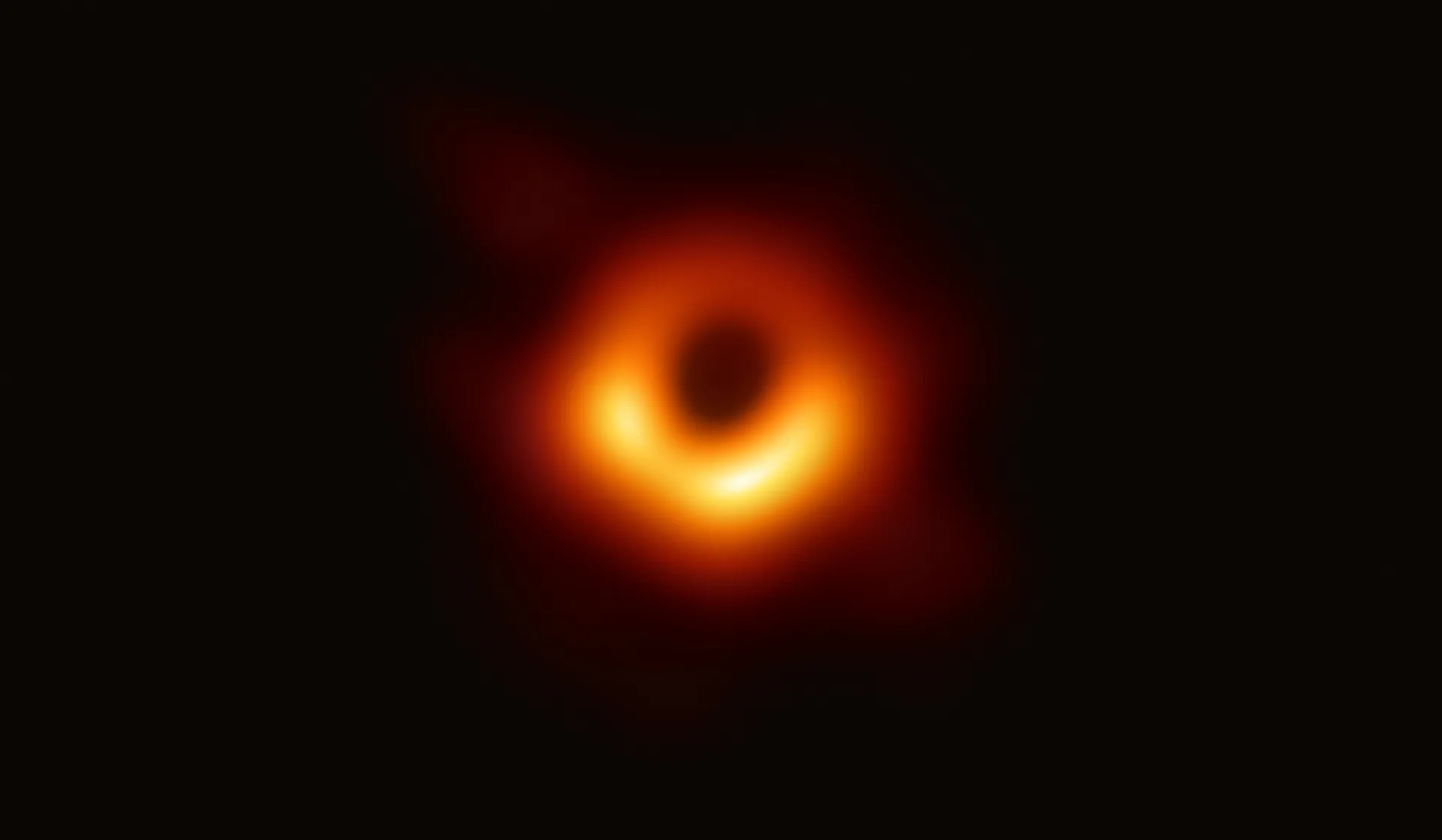
The shadow of the black hole at the centre of the galaxy M87, from radio telescopes across Earth working as one. Released on 10 April 2019; the first image of its kind. The caption gives no distance, so no light-age. Image: EHT Collaboration, CC BY 4.0.
Let’s say you fall into a black hole. I don’t recommend it, but let’s say.
A black hole is a place where gravity has won. So much mass sits in so little room that nothing inside a certain boundary, the event horizon, can get back out. Light cannot, and nothing travels faster than light.
The surprise is that the horizon itself is not a surface. There is nothing there to hit. What happens to you on the way in depends on one number: the mass.
- Width of the event horizon
- 25 million km
- The black hole at the centre of our galaxy. Its horizon is about 18 Suns wide.
- Width of the dark shadow it casts
- 66 million km
- About 2.6 times wider than the horizon itself, because the hole also swallows light that passes close by. This is the black disc in the picture.
- Stretch across your body at the horizon
- Under 0.001 g
- Far too gentle to notice. You would cross the horizon without feeling a thing.
- One hour for you, hovering there
- 3.3 hours far away
- Time runs slower deep in gravity. The closer you hover to the horizon, the faster the rest of the universe ages.
- Longest possible fall from horizon to centre
- 67 seconds
- By your own watch. Firing rockets to resist only makes it shorter.
Small black holes are the dangerous ones
Pick the Sun in the instrument above. Its horizon would be about six kilometres wide, and near something that small, gravity changes steeply from one metre to the next. If you fell in feet first, your feet would be pulled far harder than your head.
Physicists call the result spaghettification, and they are only half joking. I am not joking at all. Around a black hole a few times the Sun's mass, the stretch would pull you apart long before you reached the horizon.
Giant black holes let you in quietly
Now pick Sagittarius A*, the black hole of about four million Suns at the centre of our galaxy. Its horizon is about 25 million kilometres across. Gravity there is immense, but it changes so gradually over the length of a body that the stretch is far too small to feel.
You would drift across the horizon without any sign that you had passed the point of no return. No bump. No signpost.
What a friend would see
Someone watching from far away would never see you cross. Time near the horizon runs slow compared with time far off, so your friend would see you slow down, your light growing redder and fainter until you faded from view. Slide the "how close you hover" control to see how extreme the effect gets.
By your own watch nothing slows at all. You cross in an ordinary moment.
Inside
Once inside, the centre is no longer a place you can steer away from. It lies in your future, the way tomorrow does. In a black hole the mass of Sagittarius A*, the longest you could last between horizon and centre is about a minute. In M87*, about 1,500 times heavier, you would have about a day.
What happens at the very centre? Nobody knows. Isn’t that wonderful? General relativity predicts a point of infinite density, which most physicists take as a sign that the theory has run out of road.
Check my sums: the sizes and times in this article are worked out by the instrument above from the masses it lists, using the standard formulas for a black hole that does not spin.