Callisto
The outermost of the four, with a surface that has hardly changed in four billion years.
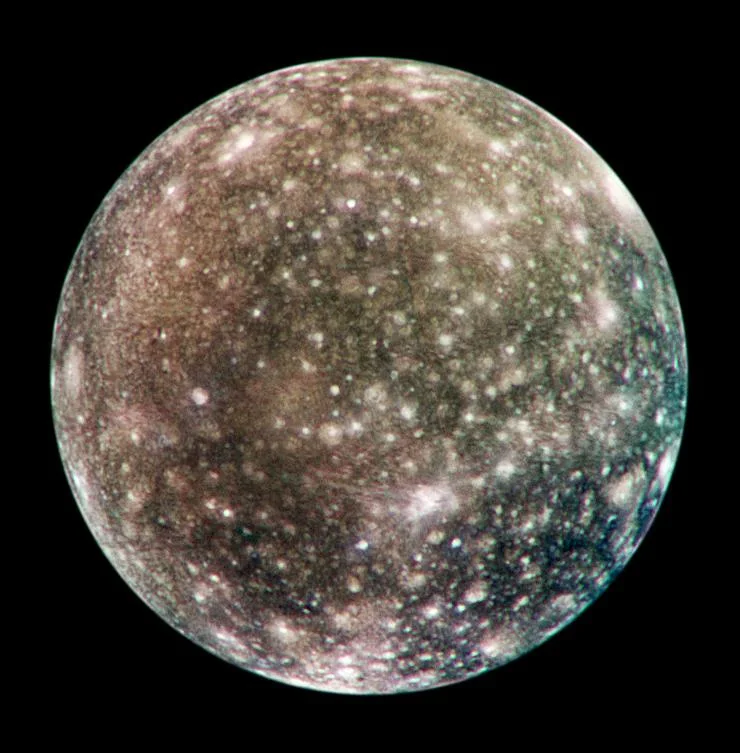
Callisto in colour, from NASA’s Galileo spacecraft. The bright marks are impact craters. The source gives no distance, so no light-age. Image: NASA/JPL/DLR.
- Distance from Jupiter
- 1,882,700 km
- One orbit
- 16.69 days
- Diameter
- 4,821 km
- Discovered
- 7 January 1610, by Galileo
Callisto at the site clock’s time
Wind my clock at the bottom of the page and this follows.
- Doing the sums
- What this is
- The United States Geological Survey’s map of Callisto, built from Voyager and Galileo images, wrapped on a sphere and lit from where the Sun is. The only global map is black-and-white, so there is no colour here. Blurred or black patches are places no spacecraft has photographed well. Drag it sideways to wind time and watch it turn.
- What is simplified
- Callisto is drawn keeping one face exactly toward Jupiter, with its axis parallel to Jupiter’s. The real moon rocks about a degree or less either way.
Distances and Jupiter’s disc are to scale. The moons are drawn larger than life so you can see them.
- Io
- Doing the sums
- Europa
- Doing the sums
- Ganymede
- Doing the sums
- Callisto
- Doing the sums
- Callisto from Earth, at the site clock’s time
- Doing the sums
- Next time its shadow crosses Jupiter
- Looking
- What 70 kg on Earth would weigh there
- 8.9 kg
- From its surface gravity of 1.24 m/s² (NASA).
What we know
An old face
Callisto’s surface of rock and ice is the oldest and most heavily cratered in the solar system, about four billion years old. I can’t keep a desk tidy for a week. It is Jupiter’s second largest moon and the third largest moon in the solar system.
Data from the Galileo spacecraft in the 1990s hinted at a salty ocean inside. NASA now adds a caution: later research suggests the ocean may lie deeper than first thought, or may not exist at all.
Callisto orbits far enough out that it takes no part in the rhythm shared by Io, Europa and Ganymede.
Visitors
Pioneer 10, the Voyagers, Galileo, Cassini and New Horizons have studied Callisto, and Juno has photographed it. ESA’s Juice is planned to fly past it 21 times between 2032 and 2034, coming as close as 200 km.