How to find Jupiter's moons with binoculars
Four of Jupiter's moons are bright enough to see with ordinary binoculars. Here is how to spot them and how to tell which is which.
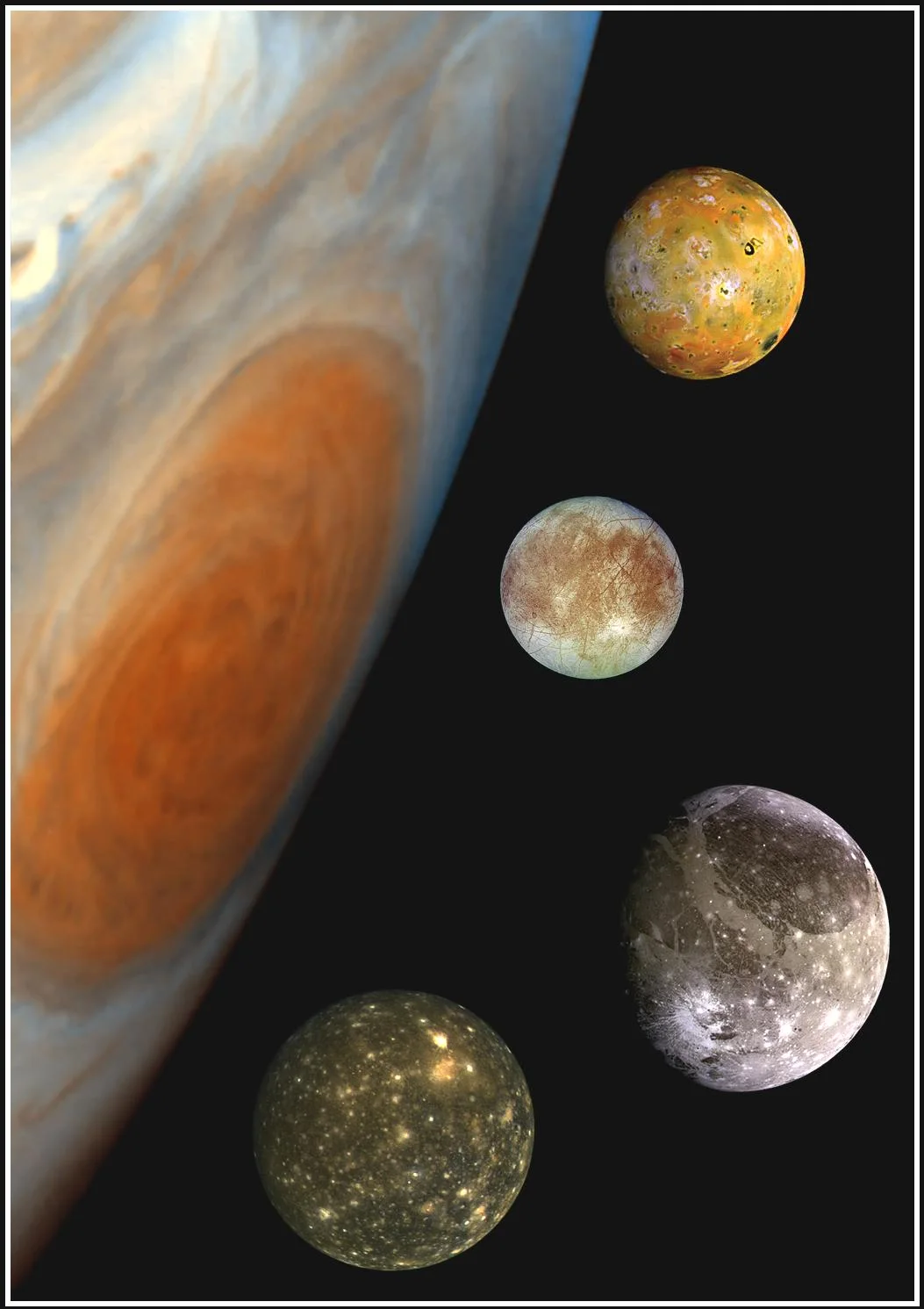
Composite. Jupiter’s limb with the Great Red Spot and, top to bottom, Io, Europa, Ganymede and Callisto. A composite of separate images from NASA’s Galileo and Voyager spacecraft, arranged for the picture; the moons are not in their real positions. Pieced together from several pictures: no single light-age. Image: NASA/JPL/DLR.
In January 1610 Galileo pointed a small telescope at Jupiter and saw points of light beside it that moved from night to night. You own a better instrument than he did. It is probably in a drawer. An ordinary pair of binoculars shows the same four moons, and they are still there.
What you need
Binoculars marked 10×50 or 7×50 are enough. The hard part is holding them still. I shake like a leaf, so I know. Jupiter is so bright that its glare swallows the moons if the view shakes. Lean against a wall, rest your elbows on a car roof, or mount the binoculars on a tripod.
What you will see
A bright disc with up to four faint stars strung out in a line on either side. The line follows Jupiter's equator, because the moons orbit above it and we see those orbits nearly edge on.
Distances and Jupiter’s disc are to scale. The moons are drawn larger than life so you can see them.
- Io
- Doing the sums
- Europa
- Doing the sums
- Ganymede
- Doing the sums
- Callisto
- Doing the sums
This is the view for the time on my clock, the site clock at the bottom of the page. Slide it forward to tonight, go outside and compare. If we disagree, tell me.
Telling them apart
In binoculars they all look alike: four dots. Position and speed give them away.
- Io stays closest to the planet and laps it every 1.77 days. It visibly moves within an hour.
- Europa takes 3.55 days and reaches about one and a half times as far out as Io.
- Ganymede takes 7.15 days. It is the largest and usually the brightest of the four.
- Callisto takes 16.69 days and wanders furthest. It can sit a long way from the others, and often does.
When you count fewer than four
Often one or two are missing. A moon may be passing in front of Jupiter, hidden behind it, or sitting in the planet's shadow. Two moons can also be too close together to separate. Nothing is broken. Wait an hour and look again.